Act For Nature- sharing the unique biodiversity of SBWR with a friend

Near the mangroves @ SBWR

My friend in my masters program had always struggled to find time during the semester to explore Singapore. I used to share stories about the BFF field trips with him and he used to be amazed about the various flora, fauna, ecosystems that Singapore holds. He is interested in disaster management and his hometown in India is prone to floods. I decided to take him to SBWR during the summer break to share about the brilliant learnings I had on my field trip with BFF, to help him see what Singapore holds in terms of biodiverse ecosystems and especially the mangroves.

We started at the Neo Tiew Crescent and I showed him the common fruit bats at the entrance. He was a little scared of them but appreciated that we could sight some wildlife which he had never seen before in the first minute of the walk. As we started to walk towards the mangroves, there were giant red army ants on the railings. He had never seen such ants before and started to click photographs of them. This made me feel good that I gave him the chance to engage his curiosity about wildlife and become a part of the experience by clicking photographs. He was mesmerized by the greenery around us and felt rejuvenated.

A few more turns later we had arrived to the viewing deck which gave us views of Johor Bahru. He video called his parents back in India to show them a glimpse of Malaysia and the beautiful greenery of dense trees around us.

He was amazed to see red army ants for the first time so clicked some photographs

We then came across the mangroves and I shared with him about the coastal degradation and how the roots were now exposed to air rather than to the rich ecosystem of soil, salt water, etc. He was immediately able to think about its repercussions to the risk of floods. He also noticed many plastic bottles lying around wherein I explained how the waste disposed in the water then washes into the coastal area of mangroves, gets stuck in the roots and impedes wildlife associated with the mangroves. This is where we saw the giant mudskipper which was exciting for both of us.
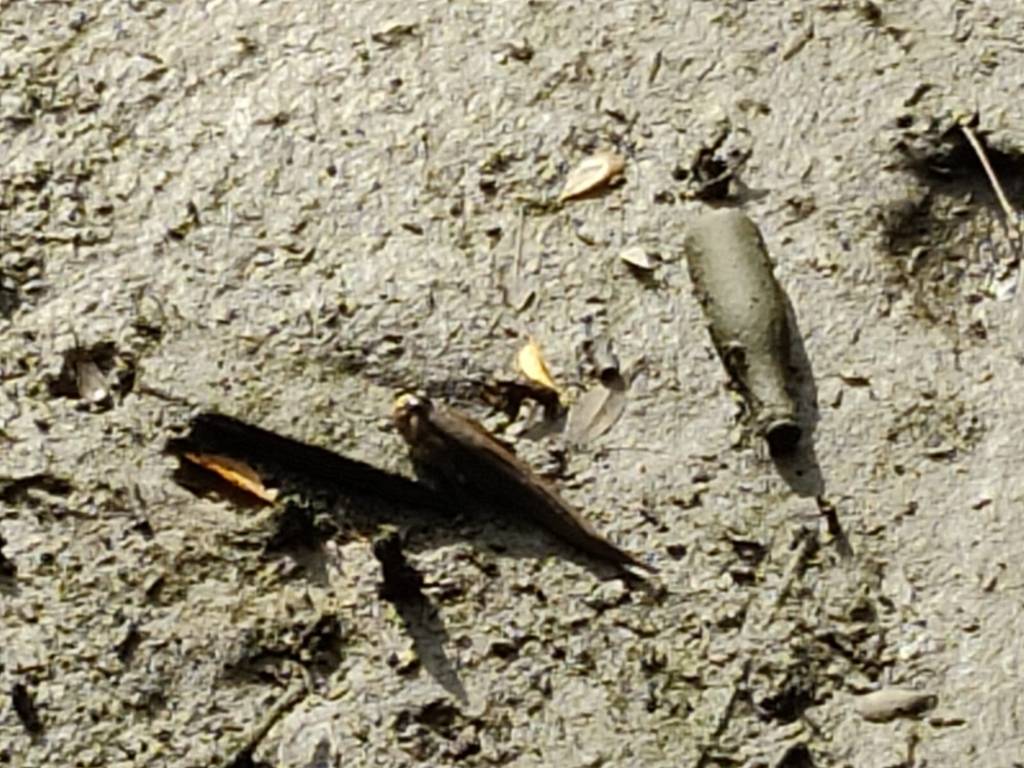
Giant mudskipper

He then asked me about a constant cricket like loud noise going on continuously in the background. I told him that it was a cicada and we both started to look for the insect on the nearby tree. I was able to locate two and show it to him. We have cicadas even at College Green, NUS hostel, and he then said that he was amazed to finally understand the source of the sound he was hearing for the last 6 months.

Cicada

While walking towards the prawn pond and viewing decks, he happened to see a monitor lizard which was huge. He made many videos of lizard walking from one end of the walkway to another. I was happy to see him looking at flora and fauna of Singapore for the first time and that he was enjoying his time and engaging with nature.

Monitor lizard

I also showed him the fish tail palm and share about civet cats. He said that now when he comes across this particular plant, he will be able to recognize its name and thus was happy to learn something new about his surroundings.

We soon came to the area of migratory birds and I shared the stories of the Whimbrel and the flyways used by birds to migrate. I also told about bird ringing and how we can track the same bird in its path on the flyway. We sadly did not have binoculars so I could not show him the birds I could see during my field trip with BFF. We did see one crocodile which was good.

He shared the following with me after we returned from SBWR-

“I had an amazing experience at Sungei Buloh Wetland Reserve. The long morning walk was a refreshing one alongside of Mangrove plantations. Witnessing Mangroves was a great reminder of how our ecology needs to be balanced for sustainable living. I also got the opportunity to sight monitor lizard, giant mudskipper, crocodile which was quite exciting to see from such a close distance”

My key takeaway is that everyone these days is busy with work and is unable to appreciate the nature around them. Few of us who had the opportunity to learn about Singapore’s biodiversity now hold the responsibility to share the information with our friends and family. The positive thing is that even if people are busy, they are curious to know about wildlife and excited to learn when someone shares with them. Being in nature also helps them relax and reconnect with themselves.

I thus decided to experience this act of being the medium of such an experience for someone. I am happy that I was able to pass on information about Singapore’s biodiversity conservation efforts with a friend who is a nature enthusiast and am optimistic that this will help him in his future endeavors back in India while he works on disaster management efforts.

This was my Act for Nature and I am grateful to have received the opportunity for it. Thank you BFF!

Bird flyways, mangrove health and much more @ Sungei Buloh Wetland Reserve

Common fruit bat

A long travel from Botanic Gardens to Sungei Buloh introduced me to one side of Singapore that I had never seen before. It almost felt like I have reached another country. Indeed, at one point on our walk around the wetland reserve we could see Malaysia’s Johor Bahru and I clicked a selfie with Malaysia.

This walk was power packed with witnessing mangroves, crocodiles, snakes, birds and discussing about something I had never thought about- Bird Flyways. They are flight paths used by birds when migrating from one point to another. Our guide took us through this new world of routes followed by birds during migration at a shelter which was designated to provide closer views of birds around a quarry and posters of information about bird species which had been spotted there. The guide shared about the East Asian Australasian flyway which stretches from the Arctic in the north to Australia and New Zealand in the south. As development of areas is increasing, the transit sand stops for the migratory birds are also reducing in number. I was curious to know that as these birds are migratory, which country takes responsibility for catering to their needs when one might arise. I was happy to learn that they belong to all the countries in their route and everyone shares the responsibility together making me wonder as to why many countries fail to cooperate on other fronts. The guide also shared about a practice called as bird ringing or bird banding wherein a green flag is tied to the leg of the bird for identification and tracing along the flyway that it may follow. He also shared the story of a Eurasian Whimbrel who was captured twice in the Sungei Buloh area around two decades apart in 1995 and 2014, suggesting that this is a story of how birds can persist and survive even when ecosystems are getting affected.

Here we saw sunbirds, common redshank, mullets jumping out of the pond for air, egrets and common sandpiper. Hovering over the air were few white bellied sea eagles. On one narrow route we could spot the green tree snake and a pair of water monitors who were trying to mate. At another turn, I saw the biggest water monitor that I have seen in Singapore. We saw at least 5 crocodiles and the most interesting one I saw was tailless!!

We also got to witness how coastal erosion has affected the mangrove ecosystem. The coast has depleted and the black/green marking visible in the roots are signs of earlier coastal levels (as visible in the attached image). We could also see a lot of plastic bottles washing up to the coast and residing among the roots of the mangroves. The guide shared that large scale plastic removal is one of the priorities of the Singapore government with respect to mangrove preservation. We also learnt that mangroves are an important carbon sink called as blue carbon. Now there are manifold reasons for mangrove preservation. They protect against floods, store carbon and provide ecosystem for wildlife. Human life is dependent on these preservation efforts.

This experience has been one in which I have been introduced to very local effects of ecosystem changes due to climate change, interconnected nature of various plant and animal species and how Singapore is committed to deliberately balancing human development with ecosystem conservation. I thank everyone at the Biodiversity Friends Forum and the allied minds behind it for this opportunity.

Birds of Ubin

Sunrise from the ferry to Ubin

The morning started with a beautiful ferry ride from the Changi ferry terminal to Ubin. The wind was amazing and we got to the see the sunrise. This was the first time I went to Ubin and travelled on a ferry to an island from Singapore. Right at the terminal as we stepped on the boardwalk there was a bunch of Asian glossy starlings waiting to greet us on a day which would greet us with many other bird species.

As we started walking, we all happened to glance over a huge tree and saw two hornbills starting off with their morning routine. The ardent bird watchers from the group had brought along their cameras and binoculars so that we could get a good zoomed in magnified look at the birds. Then we reached a small pond where we saw many grey heron. On the sky above us, we saw white bellied sea eagles flying gracefully. One of the students shared that they are the largest avian predator in Singapore. In the same area, there was a fence on which there were many grey heron. When I looked from the binoculars, I saw a black bird sitting gracefully spreading its wings. The others confirmed that it was an oriental darter.

Walking further on our journey, the life sciences students shared that environmental conservation efforts and planting new species of trees and shrubs have actually borne fruit and the number of species of wildlife and the population sizes of the existing species have started to go up. They also shared how plants are intelligent and have a way of communicating with each other. This then introduced me to the broader concept of ecosystem health. This reflects the condition of an ecosystem and can be judged by the species it can harbor. Sinking into the biodiversity of the Ubin island made me realize that ecosystem health can be restored and continuous collaborative efforts are needed to maintain the rich nature that we are embedded in.

Further along the journey we reached the campsite where we saw a plethora of different birds like the bee eater, scarlet back flowerpecker, olive green bulbul, pink neck green pigeon, white rumped sandpiper and the emerald dove. It was a magical experience looking at so many colorful birds all at once in a short span of 3 hours.

There were also some monkeys in one area playing around and jumping from one tree to the next. I clicked good photographs to become a part of nature and feel lucky to have been a part of the group that was blessed to see so many birds of Ubin.

First nature walk @ Bukit Batok Nature Park

The first step on the journey itself was unique for me as I started to feel disconnected from the world of internet while travelling towards the location. My mobile internet was having some issues that day and I had to navigate my way to make it to the Nature Park while relying on people to ask for directions. The feeling was good and I felt present in the moment without the distraction of constant messaging. Uncle Tony was our guide that day and the discussions I had with him helped me a lot. He introduced us not just to the wildlife of the park itself but to the environmentalist movements around it which were responsible for advocating for its conservation. He shared that how the connectivity between the conserved areas was crucial to maintain the gene pool of the plant and animal species.

On our walk, we saw various plant and tree species such as the cinnamon tree, golden leaves of the durian tree where we shared a laugh on how Singapore’s uncles and aunties can quarrel over the durian falling down from the tree, rubber tree, nutmeg, the fishtail palm, etc. I was lucky to see a Colugo glide from one tree to another. We heard the sounds of the owl and heard stories about civet cats. Uncle also showed us the mickey mouse ear leaves of the mango tree, a beloved fruit in India.

Uncle Tony and I also discussed shared interest in astronomy using telescopes wherein mine was focused on appreciating the beauty of celestial objects whereas his was more towards religious aspects of astronomy and culture. We both agreed that in today’s day and age where our minds are constantly in receipt of information, we tend to forget to look around and above at the sky to become cognizant of our existence.

When asked about his experience towards doing work around biodiversity, Uncle Tony shared that policy makers get on board with environmental conservation in urban planning when you pitch incremental changes rather than big bold one shot ones. He said that change is a slow process and educating the young generation about it is pivotal to carry on the good and important work.

We then wrapped up the walk with a selfie in masks and I headed home feeling that my horizons of looking at the world had just broadened in a 3 hour group activity in nature.