50 Shades of Brown: Horseshoe Crabs Survey @ Kranji Mudflat

This is personally one of the field trips that I really looked forward to, as I first heard about Kranji Mudflats and the horseshoe crab surveys that has been done there from none other than our guide that day – Lester Tan.

We gathered for a quick intro and briefing about the importance and role of Kranji Mudflat and the main star of our presence that day, the horseshoe crabs.

Kranji Mudflat

Mudflat is a stage just before the formation of mangroves (it’s the crib of an upcoming mangrove). Mudflat is formed when silt and sand from estuaries flow out to be deposited left and right.

Lester asked us: Apart from squishy muddy soft, what’s the texture of the material here? (we did not know). Crunchy. Not that we tried biting or tasting, but the crunch comes from when dead mussel shells are stepped on.

On this note, he introduced about the issue of invasive mussels. The only native mussels in Singapore are the green mussels. As for the Zebra mussels, they are invasive and has already established and stabilised themselves around Singapore and found pockets of places where they prefer. This is an issue because they hinder the lifestyle and survival of horseshoe crabs. More on this later.

Lester also emphasised that as biodiversity friends, the word of choice when referring to nature areas such as mudflats are very important, as they paint a subconscious impression to the listener. Instead of using descriptors such as smelly, dirty, muddy, boring and ugly, we can get creative and use more positive descriptions (shall leave it to us all to explore our creativity).

Kranji Mudflat is the largest area for breeding ground for mangrove horseshoe crab in Singapore. It stretches all the way from Sungei Buloh (West) to JB Checkpoint (East “Mandai”).

Types of Horseshoe Crabs

Contrary to popular believe, horseshoe crabs are not crabs, but more related to insects/spiders/scorpions than crustaceans. It is because of this that a government policy to protect them because far more complex to formulate (to a layman it may sound like, do we need to protect all insects too?)

There are four types of Horseshoe Crabs aroudn the world:

  • American/Atlantic Horseshoe Crab
    Gigantic and huge, they have blue blood
  • Chinese Horseshoe Crab
    Smaller than Atlantic Horseshoe crab, but still big in size.
  • Tri-spine / Coastal / Pacific / Indian Horseshoe Crab
    They have spikes on their tail and their body can grow up to the size of a person’s face. Can be found in Japan, Brunei, Sabah and open water around southern Indonesia.
  • Mangrove Horseshoe Crab
    Smallest among the 4, growing up to only palm size. They are found around Asia, up to even India.
    They are technically poisonous to consume due to deadly neurotoxin within, but some still will try to eat them, especially females that carries eggs. They have rounded tail which feels smooth and have much shorter/almost nonexistent spikes as compared to Tri-spine Horseshoe Crab.

Horseshoe Crab Anatomy (for layman)

Their mouth is attached to their legs, so they chew and grind their food as they walk. They feed on worms and basically anything on the mudflat and are bottom feeders. They have more than 2 eyes (uhmmm this tickles my arachnophobia): 2 feeding pairs at the bottom to locate food and up to 10 eyes (note: not pairs) that are sensory to determine tide level, time of the day and the moon brightness.

Horseshoe crabs are not venomous and their tails are NOT used for defensive purposes. Their tails exists so they can flip themselves upright and are crucial to their survival.

Fun fact: Horseshoe crabs can swim upside down. They also have boot gills to help them breathe outside water during low tide.

Challenges faced in Singapore

  • Habitat Destruction: need I say more?
  • Land Reclamation: the ultimate killer of most shore and reef biodiversity.

Survey guide:

To differentiate gender, look underneath. Females have uniform legs that are pretty and slim. Females are also usually way larger than males. Males have two bulging arms. Anything with a pit-to-pit measurement of 7.5cm and below are considered juvenile. During mating season, Male HSC will latch onto Female HSC using their 2 forearms. Males don’t eat while mating while females will continue to walk around to eat.Sometimes, multiple males will go for 1 female, and all will latch onto each other until the female decides to dig a hole to lay eggs. The first male right behind the female will fertilise the eggs.

HSC Predators are less studied. The list below are general understanding at this point:

  • Atlantic HSC: sea turtles red knots (shorebirds) – they are high protein to the predators
  • Mangrove HSC: not sure who eats them, crab eating macaques, crocodiles, storks and otters. Otters sometimes play and kill but don’t really eat them.

The good thing today is that, after being highlighted by the scientific community, horseshoe crabs have been given an IUCN status, whereby with a IUCN status, it’ll be easier for government and relevant parties to push for conversations and policy making.

IUCN status:
Mangrove: vulnerable
Coastal: endangered

Other than that, there are currently still no laws that protects horseshoe crabs from being harvested or poached from the wild.

AFN – Impromptu Walk @ Woodlands East Park

Two friends of over 15 years wanted to meet once last time before one of us enters her married life. We decided to change up our usual meet ups at cafes and indoor spaces as we want to explore more parts of Singapore. It’s a decision I highly supported!

Recommend!!

On the actual day, 10 July, we narrowly avoided the morning showers as we almost decided to go in the morning. We took a nice 10-min walk from Marsiling MRT to Blk 134 before reaching the Woodlands Town Park East. Weather was great and sunny, heng ah!

We-fie with the park sign! We recommend 🙂

We first got to know about this park from MothershipOnEarth instagram post. There is a small portion of this park that has been initiated, created and maintained by this pair of father and son over 2020 when the pandemic first hit our nation. The park features a variety of ornamental plants with flowers that attracts many kinds of pollinators such as bees, butterflies and other insects.

As it was all of our first time visiting this park, I had no clue what flora and fauna can be found there.

Many types of flowering plants can be seen!

The park sits at the base of a small hill. We entered from the other side of the hill, so there was this section of big steps to climb, slightly similar to the park in Bukit Batok. Upon reaching the top, we paused to admire the scenery around and started envying the residents around.

Thereafter, we spotted our first fauna friend of the day: Scarlet-backed Flowerpecker. I brought my binoculars and started looking at it, but could not get a picture before it flew away. What.a bummer! We started walking around the top before proceeding down the tiered steps to the actual ornamental flowers park.

Along the designated paths, I introduced about a few plant types that we see along the way: Simpoh Air, the symbiotic relationship of ants, aphids and Macaranga tree, Chempedak, Indian Snakeweed and many more common garden sightings.

A cool grasshopper/locust family guarding the Chempedak (ok he was really just passing by). I was intrigued by its yellow and black pattern.

It wasn’t a very tough walk, just enough to make you feel fit once you reached the top. We took a walk around the top and walked downhill, The path downhill was filled with flowering shrubs and many butterflies were weaving amongst them.

Then, pause!

A flock of four Asian Glossy Starlings flew into our sight and stopped a few feet down the path that we were on. It was a good opportunity to introduce my 8×42 binoculars to my friends, how to use it and how much details they are able to see when they birdwatch with a pair of binoculars. They experienced the common challenge of focusing, looking through two eyeholes and locking in on their target.

This is a tree which initially I thought was Macaranga. But on closer inspection, the leaves are slightly different. Nevertheless, my friends were intrigued by the symbiotic relationship between the ants, the aphids and the Macaranga plant.

Bukit Batok Nature Park (BBNP) Night Walk (1 Apr 22)

Apart from camps at Pulau Ubin, I have never done a night walk in nature areas in Singapore due to the 7-7 opening hours.

Our guide, Uncle Tony, is an expert with trees. He shared that the highlight of our trip would probably be spotting the big three of BBNP: Malayan Colugo, Palm Civet Cat and Flying Squirrel — almost a guaranteed sighting. Read on to find out if/when these hosts showed their face!

We started the walk right at the carpark area. Uncle Tony started introducing almost tree after tree, plant after plant from the carpark to start of the path. Here are some that we saw that night:

  1. Sea Apple – there are 36 species!
    A question that Tony prompted us was: Why would a Sea Apple tree be found so deep in mainland? Singapore’s small land has a part in this question, but more so of the history of how it was brought in.
    In late 1800s, Teochews wiped out forests for their Gambier plantation. 15 years later, the land was overgrown with lalangs, both plants that grow well on poor soil. As these plants acts almost like tinder to starting a forest fire, this area became prone to forest fire due to the high likelihood of lightning strikes. As a method of mitigation, Sea Apple was planted as a fire breaker, to shade the ground below, hence reducing lalang growth.
  2. Simpoh Air
    This is a common shrub that are found at many parks around Singapore. It produces fruit that has a lot of little seeds which attracts birds. It is an important food plant for the ecosystem.
  3. Figs – there are 30+ types of figs in Singapore. (We were looking at ficus glossuroles)
    Figs are important because they flower and fruit at different times throughout the year. They are a good food source for fauna in an ecosystem. Another example of a common but not low class plant.
  4. Rubber Tree
    A common tree in my workplace at Pulau Ubin – this tree has seed pods with cool seeds. They can be easily identified by how their leaves always grow in sets of threes.
  5. Singapore Rhododendron
    The leaves of this plant have characteristic 3 veins.. The leaves are crushed to be applied over injuries during the kampung days. Kampung knowledge of plants and their medicinal values are often passed down from the matrimonial side.
  6. Birds Nest Fern
    The overhanging dead leaves and root materials provides a great roosting site for fruit bats. Will be sure to observe bird nest ferns more closely after knowing this!
  7. Rain Tree (non-native)
    Rain Trees are from the United States, but somehow flourish and grow well in Singapore. It can provide shelter and home for many kind of birds,
  8. Wild Orchid (ok we weren’t able to ID the specific name)
    Orchids need a specific amount of shade to thrive.
  9. Ten Men Tree
    Characteristic ripped apart bark due to the diameter growth of tree trunk. It has a fluted buttress and can grow really tall

While Uncle Tony was introducing about these trees and plants to us, we were also on the lookout for the big three. We spotted fresh Palm Civet poop, but did not see the pooper around. Other than a chicken roosting on the tree (cannot determine if it’s domestic chicken or jungle fowl due to poor lighting), we did NOT see any of the big threes. What a bummer, as some of us has never seen any of the big threes before.

^ Said chicken

Uncle Tony was also surprised that none showed up today, and since then, our group became THE group which didn’t spotted any of the big threes among subsequent BBNP night walks. :’)

Here’s the little plot twist after the walk:
I waited for my bus after we parted ways, but missed 2-3 as it was getting really late and drivers drove past that ulu (deserted) bus stop really fast, assuming no passengers wants to board. I eventually decided to try my luck at a different bus stop which has a higher likelihood of stopping the driver in time and had more bus numbers that went my way. On the way to that bus stop, I noticed something rustling in the grass patch beside me. Turns out it was a hungry Palm Civet looking for food! It froze when it saw me, and very dramatically moved into the dense vegetation in a slow-mo manner. That lifted my spirits completely!

My first sighting of an Asian Palm Civet

While waiting for my bus at the next bus stop, I was looking hard at the bright car lights to spot the numbers I need. All of a sudden, a squarish shadow swooped from the dense vegetation of BBNP onto a lone tree planted between the roads. It then started climbing upwards and went too far for my naked eyes to see. That makes it 2/3 for me that night! I was beyond delighted by the surprise presence.

Thanks for sharing knowledge and for learning together!!

This field trip was personally really memorable because of the sightings at the end after we parted ways. Also, a big thank you to Uncle Tony as the things that he shared were eye opening, My favourite takeaway line from him during this walk would definitely be:

A common plant doesn’t mean it’s a low class plant.

Uncle Tony

Bishan-Ang Mo Kio Park (22 May 22)

Disclaimer: No nat-geo quality photos in this post, and not all that we saw were captured in photos either :’)

Singapore’s Bishan-Ang Mo Kio Park used to be a concrete canal just like many other existing ones around the island. However, efforts have been put in to revitalise and turn this place into a bioswale. According to NATCO.org, Bioswale is a vegetated, shallow, landscaped depression designed to capture, treat and infiltrate stormwater runoff as it moves downstream. In other words, everything is naturalised. Flooding helps to create an environment that offers different types of habitat for biodiversity. Compared to the common concrete canals, B-AMKP is an excellent example of adaptation of a city while taking nature into consideration — establishing an ecosystem while solving the original surface runoff problem. Despite hearing much about this park, I have only passed by it on the way to a friend’s house

To kickstart the day, I arrived at the gathering point to find out that the group chanced upon a White Throated Kingfisher. I missed it though! But that was fine, as more birds awaited.

Subsequently, we saw our most common resident: Javan Mynah. Javan Mynahs are native to Java and Bali, Indonesia, but established its population in Singapore possibly as a result of escaped pet trade, They are non-native to Singapore. However, unlike the buay paiseh (unapologetic and daring) Javan Mynahs in Singapore, the Javan Mynahs in Java and Bali are actually skittish and will not let you come close at all!

We also spotted a female Brown-Throated Sunbird, with distinctive yellow eye-ring that differentiates it from female Olive-Backed Sunbird. The latter has a yellow brow and some white on their tail edges. We learnt that they are a victim of the Violet Cuckoo (quite trendy among bird groups at the time of this field trip). Violet Cuckoos will lay eggs in unknowing sunbird’s nest and sneakily let the sunbirds raise their offspring. Only when these intruder chicks grow up, will the sunbirds realise the situation… The issue with this is the risk of parent sunbirds being worn out from constantly finding food to feed the chick which has obviously bigger appetite than a regular sunbird chick.

Along the bioswale, we saw a Purple Heron perching at the canopy of a tree. Can’t help but wonder if he was spying on the residents nearby.

Purple Heron

As we walked further, we saw a few parakeets squawking once in a while. We heard the calls of Blue-Crowned Hanging Parrot as well, which I unfortunately did not get to see using my binoculars.

We spotted a few Malaysian Pied Fantails, but the highlight of the day has got to be witnessing a pair of MPFs interacting with a female Asian Koel. We had no idea what they were doing, but the Asian Koel looked harassed by the much smaller sized fantails.

Possibly juvenile Asian Koel looking harassed by the Pied Malaysian Fantail (top).
Malaysian Pied Fantail showing us how it got its name.
Malaysian Pied Fantail working his charm

Another memorable spot was juvenile Pacific Swallows. Although they fly almost as fast as the adults, juvenile Pacific Swallows carry this young, baby vibe that makes them look adorable.

Finally, the greatest takeaway was learning from Nasry about these two terms: Precocial and Altricial birds.

Precocial birds are those who hatched from an egg with feathers ready, such as fluffy ducklings, ostrich, emus and chickens. They also don’t have gapes.

Altricial birds are those who hatch naked with no feathers but pinkish wrinkly skin. These chicks have gape as that allows parent birds to know where to feed.

That was a really interesting information as I have never explored or thought about this. Thanks Nasry!

Overall, I was slightly disappointed that I did not spot many new birds (eg. owls), but I am thankful that we still had some bizarre sights like five squirrels hanging out on the same branch the fantail-koel drama. Rest of the time during this walk was spent appreciating the beautiful park.

Look at the size of this Giant Poodle!

Nature walks like these are enjoyable, and I do look forward to exploring more local birding spots on my own.

Thank you facilitators!

AFN – Beach Clean Up @ East Coast Park

A beach clean up has always been something on my bucket list of things to try with my friends and I am glad to be able to finally strike this off the list. We chose to do so at the East Coast Park as we thought that there would be a correlation between the visitor load (since it was a Saturday) and amount of trash. We went to the park with the expectation of seeing lots of trash, but we soon realised that we were wrong as the beach seems quite clean at one glance. However, despite the seemingly clean appearance, there were still some trash and unexpected items that were picked up. These include

  • Cigarette butts – lots of them
  • Fragments of Styrofoam
  • Plastic straws
  • Ropes
  • Plastic containers and bottles
  • Dental floss
Some of the items picked up
Dental floss
Some photos during the beach clean up

Overall, the experience has been a fun and fulfilling one and I do hope to go for more beach clean ups with them (hi friends let’s go for other beach clean ups!)

Photo taken at the end

Walk @ Pasir Ris Park

Despite staying in the east, I have never been to the Pasir Ris Park and this was one of the reasons why I have decided to sign up for this walk.

Some of the memorable events and learnings include

  1. Spotting parakeets and their bird nests on the light tower on our way to the park. I was surprised as never have I thought that I would see bird nests being built on light towers. These parakeets were introduced into Singapore, and they have managed to rebuild their nests even after the multiple attempts of having their nests removed.
  2. Learning more about the fish poison tree where the flowers are pollinated by bats. It was used to stun fishes in the past and enables the fishes to be captured while leaving them edible for human consumption.
  3. Learning more about the mangroves which serve as coastal protection (interconnected roots help dissipate forces of storms), carbon storage, and protection for small fishes. Some adaptations for growing in or near the seawater include having roots that do not take up the salt or having leaves that excrete the salt taken up.
Bird nests on the light tower
Fish poison tree
Flowers of the fish poison tree

Overall, the walk has been an insightful one and to end off, I would like to thank our guide, Nasry, for sharing his knowledge with us.

Chestnut Nature Park Walk

I had initially wanted to go for the walk at the Chestnut Nature Park back in early April but was unable to do so in the end, and I was really glad that there were more walks at the nature park thereafter. From the sharing by the guides, I learnt that the Chestnut Nature Park acts as a buffer park, serving as a buffer between the nature reserves and the urban areas, as well as reducing the pressure and stress on the Bukit Timah Nature Reserve, a popular nature reserve with large crowds. In addition, I have learnt that the nature reserve has routes designated for mountain bikers as well.

Some of the memorable events include

  1. Being attacked by ants – I went into the park being fully prepared against the mosquitoes but was attacked by ants instead. Although this was something that I had not expected, I am thankful for this which taught me to be more aware of the surroundings and to be more mindful of where I am stepping, especially in nature parks.
  2. Being able to see the mousedeer which is a nocturnal animal. It was also not shy, and we were able to have a longer and closer look with the binoculars that were being passed around.
  3. Seeing a colugo – it was very well camouflaged to the tree bark in my opinion, and I took some time with the repeated pointing by the guide and my friends to be able to spot it.
Mousedeer that we saw (Photo credit to Frances)
Colugo that we saw (Photo credit to Frances)

Overall, the walk was an enjoyable one and I would say it was worth the 1.5 hours traveling time. A big shoutout to my friends for patiently pointing out what was seen, and to end off, I would like to thank our guides, Frances and Wei Jian for taking their time to share their knowledge with us.

Entomology Walk @ Windsor Nature Park

As someone who is not a fan of insects, this was a walk that I would not have signed up if not for my friends. However, I am glad that I did, and the walk was insightful and eye-opening for me. The guides and facilitator were observant and knowledgeable, spotting and identifying the insects that were small and could have been easily missed out.

Some of the memorable events and learnings include

  1. The insect snacks that the guides kindly shared with the group before the start of the walk. From the reviews given by the rest of the group, they were tasty and not as bad as I thought they would have been.
  2. Learning more about the differences between a butterfly and a moth. During the walk, we came across a butterfly and the guides shared more about how we can differentiate these two. These include their activity (butterflies being active in the day while the moths are active at night) and their antennas (thin and long, with a bulb at the end for butterflies and short feathery for moths).
Butterfly seen during the walk (Photo credit to James)

Overall, the experience was an enriching one, allowing me to be more exposed to the insect world. To end of, I would like to thank the guides from the Entomology Society and Pangolin Films, as well as our facilitator, Anna, for their time and sharing.

Cracking open a mystery: Chestnut Nature Park

The very first time I visited Chestnut Nature Park, I rushed through both the Northern and Southern trails within three hours. During this trip, the goal was to complete both trails as I had travelled a long way to get to the park. I was glad when the sign-up link for the guided walk appeared in the Whatsapp group as I really wanted a chance to slow down and find out what the park has to offer.

After doing a mini-trek up the snaking road that led to the entrance, I met up with Weijian, our guide, as well as the other participants. He started off the walk by showing us the map of the park and introducing the organisation that he represents, which is Friends of Chestnut Park. The group came about after someone/some people realised that residents who stay near the park are not even aware of its existence. It was something that surprised me greatly as the park is of substantial size and it would be hard to miss, especially as a nature lover. However, I guess people tend to miss what they don’t see and thus the group set out to educate people about the park and the biodiversity which lives within this space.

We entered a small loop in the northern part of the park and soon stumbled upon a fig tree. This particular fig tree was about 80 to 100 years old and the age was based on an estimation that was done for another fig tree of a similar size. Weijian highlighted the fact that this tree has been here since pre-war times, which serves as a reminder of how enduring biodiversity is compared to a human’s lifespan. It is also a keystone species that provides many functions such as food, shelter and the prevention of soil erosion.

I also managed to learn something new, which is that there are 3 monitor lizard species in Singapore. I’ve always thought there were just two – the Malayan water monitor (Varanus salvator) and the clouded monitor lizard (Varanus nebulous). The last one is the Dumeril’s monitor (Varanus dumerilii), which is apparently a rare and hard-to-spot species that was once deemed extinct in Singapore until an individual was sighted in 2008.

Dumeril’s monitor (Photo by Michael Cota)

Another interesting species that we saw was the Cerulean Carpenter Bee (Xylocopa caerulea). I was only familiar with the chubby Broad-footed Carpenter Bee (Xylocopa latipes) that flits slowly from flower to flower with its unique, low-pitched buzzing. The colour of the bee was pretty mesmerising and upon further research, I found out that it is one of two species of blue-haired carpenter bees found in Singapore.

Cerulean Carpenter Bee (Photo: Zestin Soh)

As a bonus, here’s a picture of a Malayan Colugo (Galeopterus variegatus) that we spotted later on. Needless to say, all of us were quite excited to see this cute creature hanging out on the tree.

Malayan Colugo (Photo credits: Weijian)

One point that really stuck with me was actually something that Weijian mentioned at the very beginning. He said that the Friends of Chestnut Nature Park is a community effort for residents, by residents. I think it’s really meaningful to involve and engage the community in such efforts as it helps to inculcate a sense of ownership and belonging towards the park among the residents. In addition, it does feel like it would be a more sustainable initiative as the members are typically residents who stay nearby and it would be logistically easier for them to consistently check up on the park and get together to organise events/guided walks.

This was a great way to end off the field trip component of the BFF program and I have thoroughly enjoyed each and every one of them. Not only were they great stress-relievers, but they also imparted new knowledge and insights about the history and biodiversity of the parks I visited. It was definitely a good decision to join and complete BFF 2022 🙂

Act For Nature- sharing the unique biodiversity of SBWR with a friend

Near the mangroves @ SBWR

My friend in my masters program had always struggled to find time during the semester to explore Singapore. I used to share stories about the BFF field trips with him and he used to be amazed about the various flora, fauna, ecosystems that Singapore holds. He is interested in disaster management and his hometown in India is prone to floods. I decided to take him to SBWR during the summer break to share about the brilliant learnings I had on my field trip with BFF, to help him see what Singapore holds in terms of biodiverse ecosystems and especially the mangroves.

We started at the Neo Tiew Crescent and I showed him the common fruit bats at the entrance. He was a little scared of them but appreciated that we could sight some wildlife which he had never seen before in the first minute of the walk. As we started to walk towards the mangroves, there were giant red army ants on the railings. He had never seen such ants before and started to click photographs of them. This made me feel good that I gave him the chance to engage his curiosity about wildlife and become a part of the experience by clicking photographs. He was mesmerized by the greenery around us and felt rejuvenated.

A few more turns later we had arrived to the viewing deck which gave us views of Johor Bahru. He video called his parents back in India to show them a glimpse of Malaysia and the beautiful greenery of dense trees around us.

He was amazed to see red army ants for the first time so clicked some photographs

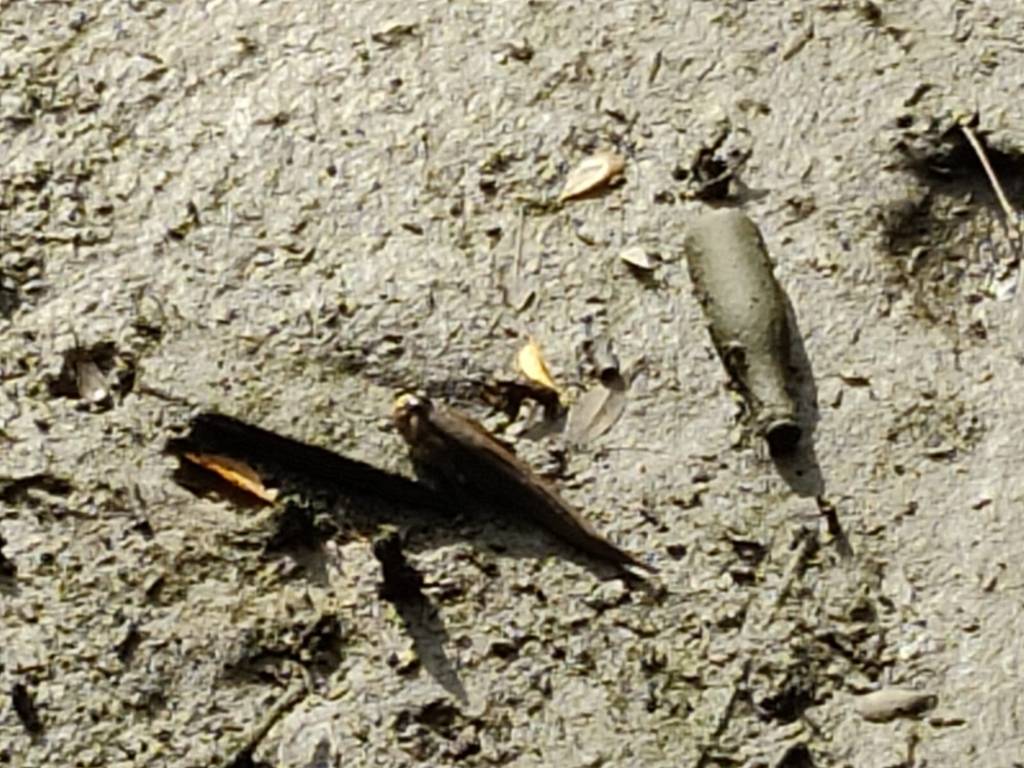
We then came across the mangroves and I shared with him about the coastal degradation and how the roots were now exposed to air rather than to the rich ecosystem of soil, salt water, etc. He was immediately able to think about its repercussions to the risk of floods. He also noticed many plastic bottles lying around wherein I explained how the waste disposed in the water then washes into the coastal area of mangroves, gets stuck in the roots and impedes wildlife associated with the mangroves. This is where we saw the giant mudskipper which was exciting for both of us.

Giant mudskipper

He then asked me about a constant cricket like loud noise going on continuously in the background. I told him that it was a cicada and we both started to look for the insect on the nearby tree. I was able to locate two and show it to him. We have cicadas even at College Green, NUS hostel, and he then said that he was amazed to finally understand the source of the sound he was hearing for the last 6 months.

Cicada

While walking towards the prawn pond and viewing decks, he happened to see a monitor lizard which was huge. He made many videos of lizard walking from one end of the walkway to another. I was happy to see him looking at flora and fauna of Singapore for the first time and that he was enjoying his time and engaging with nature.

Monitor lizard

I also showed him the fish tail palm and share about civet cats. He said that now when he comes across this particular plant, he will be able to recognize its name and thus was happy to learn something new about his surroundings.

We soon came to the area of migratory birds and I shared the stories of the Whimbrel and the flyways used by birds to migrate. I also told about bird ringing and how we can track the same bird in its path on the flyway. We sadly did not have binoculars so I could not show him the birds I could see during my field trip with BFF. We did see one crocodile which was good.

He shared the following with me after we returned from SBWR-

“I had an amazing experience at Sungei Buloh Wetland Reserve. The long morning walk was a refreshing one alongside of Mangrove plantations. Witnessing Mangroves was a great reminder of how our ecology needs to be balanced for sustainable living. I also got the opportunity to sight monitor lizard, giant mudskipper, crocodile which was quite exciting to see from such a close distance”

My key takeaway is that everyone these days is busy with work and is unable to appreciate the nature around them. Few of us who had the opportunity to learn about Singapore’s biodiversity now hold the responsibility to share the information with our friends and family. The positive thing is that even if people are busy, they are curious to know about wildlife and excited to learn when someone shares with them. Being in nature also helps them relax and reconnect with themselves.

I thus decided to experience this act of being the medium of such an experience for someone. I am happy that I was able to pass on information about Singapore’s biodiversity conservation efforts with a friend who is a nature enthusiast and am optimistic that this will help him in his future endeavors back in India while he works on disaster management efforts.

This was my Act for Nature and I am grateful to have received the opportunity for it. Thank you BFF!