We gathered early in the morning at Bishan-Ang Mo Kio park to experience bird-watching. Personally I have never been bird-watching and it was truly an eye-opening experience going for this trip. We were first greeted by the sight of roosters. Great call to the morning! Did you know? There are roosters and there is another bird similar to the rooster, called the jungle red fowl. You can tell the difference from the colour of their legs.
At Bishan-Ang Mo Kio park, there are many different types of birds that live there. We saw birds such as the King Fisher, the purple and grey herons, as well as the sun bird. We saw birds such as parakeets but these birds are non-native, they could have been pets and were irresponsibly released. Too many birds that do not really belong in the habitat will cause some disruption so it is important to remind family and friends to consider carefully before purchasing pets.
I realised that bird watching is a lot about being observant. Through this trip, under the patient guidance of the guides, I got to hear the sounds made by the birds. It is not very loud but if you listen carefully enough, you will hear it. We also needed to keep a lookout because with many animals, they won’t just stay there for you right? So we need to pay close attention. Some useful tools to have will be a pair of binoculars and a camera.
I also got to witness the interactions between the birds. Nature is all about seeing the interactions between animals and the environment and enjoying it requires us to be patient and observant. As this is my third and last trip for this challenge, I think the trip really made me realised what it means to take time and see what is around us in nature. With that, thank you to everyone who made this trip memorable. Thanks for reading!
The Pasir Ris Guided Walk was my last field trip but certainly not the least. From my (little) birding experience, I knew that there were a lot of birds there, so I was rather excited for the trip.
We met up at the mrt station, then headed towards Pasir Ris Town Park, where we saw a gigantic bird nest built on top (or rather around) a big lamp post. What looked at first to be an eagle nest turned out to be a parakeet apartment. There was more than one parakeet living in that nest, but the sheer size of the nest was magnificent. I was really amazed at the parakeets’ skills because they were so much smaller than the nest that they had built. Our guide, Nasry, also explained that the authorities had tried to remove the nest before as the parakeets were pooping into the swimming complex right below them. However, every time their nest was removed, the parakeets would simply build it again. In the end, the authorities left the nest there. Man-0, Nature-1 . 😀
The giant parakeet apartment.Monk parakeet (my lifer)!
We then continued to Pasir Ris Park, which I didn’t know was different from Pasir Ris Town Park. We saw a Grey Heron waiting for some prey, as well as different species of parakeets like the Rose-ringed Parakeet and Red-breasted Parakeet. We also saw a pair of juvenile Yellow-vented Bulbuls, which I had also recently seen right outside my house. They were really cute, and you could see that their beaks had a little yellow base. One interesting fact our guide explained to us was that the beaks of juvenile birds are normally bigger so that their parents can stick their beaks in to feed them.
Grey HeronRed-breasted ParakeetJuvenile Yellow-vented BulbulsSome of the birds that we saw!
Moving on, we entered the mangrove area. I had hoped to see some snakes because I had heard that several snakes could be spotted there. Unfortunately, we didn’t spot any snakes, but well, nature is unpredictable after all.
As we walked along the mangrove boardwalk, our guide told us many interesting fun facts about the flora and fauna there. He explained about the different kinds of roots mangrove trees have, namely pencil root, cone root and knee root. He also showed us the propagules on a mangrove tree that had fallen down. It was really interesting to learn that the propagules are what help the mangrove trees propagate, and that they weren’t really considered fruits.
Throughout the walk, we spotted many interesting flora and fauna, and I learnt a great deal from our guide, Nasry. Overall, it was a really fun and enriching walk, and I’ll definitely be visiting Pasir Ris Park again for their resident birds!!
Other Interesting Finds!
Blue-throated Bee-eaterDoggo!Juvenile Monitor LizardSquirrel feasting whilst dropping food on us!
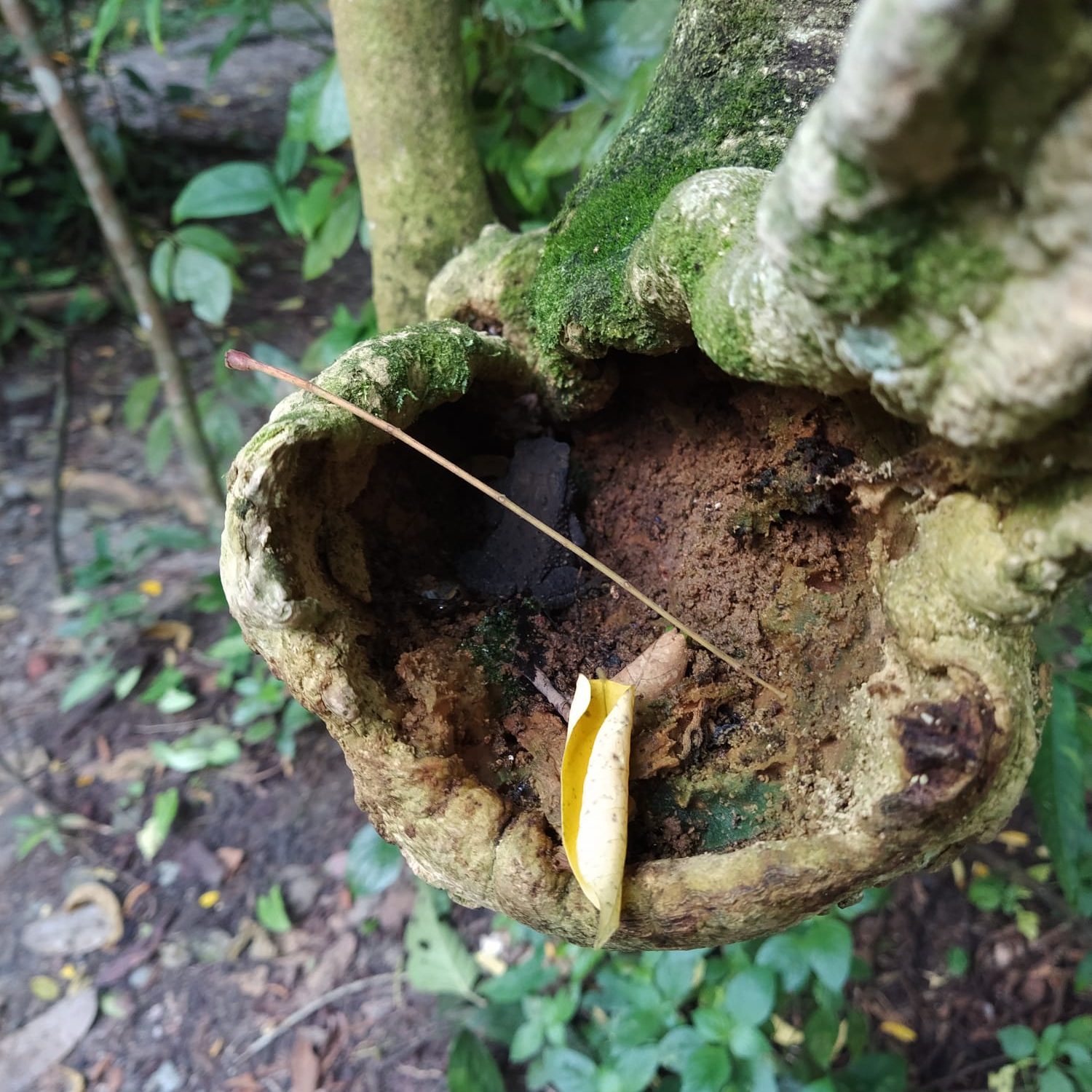
It has been a long long time since I had to wake up before the sun rose. Having no experience in birdwatching, I left home light: with a water bottle, insect repellent and my phone for taking photos. I realised my mistake when I arrived and saw people armed with some of the biggest cameras I have ever seen. Lesson learnt for the next time, as I only got photos of the macaques and a toad resting in a tree. Cute, but not the photos I was expecting on a bird tour.
very cute and tiny toad
The tour itself was very enjoyable, despite my lack of photos. It has been quite some time since I last had the time to go on a nature walk, and I was glad that we spotted quite a number of interesting wildlife. Or heard, mostly. I never knew how noisy the forest could be in the early morning, but what was even more amazing was that our guide Jeff could match the multitude of calls to specific species of birds. Not only that, he was able to pinpoint the bird on trees with little effort. Thanks to him, I was able to take a look at them through a borrowed pair of binoculars, though most of the time the tiny birds only appeared as a tiny black blob perched at the top of very tall trees. A better view of the birds were offered through the photos taken by the aforementioned gigantic cameras. There were Asian glossy starlings, heard and spotted right at the start of the walk. Then there was a racket-tailed drongo resting on a tree, though the poor thing had lost both of its “rackets”. Other birds spotted included the Dollarbird, the Green-backed flycatcher, a Red Junglefowl walking through the trees and Long-tailed parakeets. We heard many more birds that we sadly did not manage to catch a glimpse of, such as the Red-crowned Barbet and the Dark-necked Tailorbird.
On top of learning about different types of birds, we also learnt about some important plants that were found in the nature park. There is the Australian Mulberry Tree, which is a food source to many birds as well as other animals. There was a spot in direct view of a large Australian Mulberry Tree that was supposedly great for spotting birds, but that tree was taken over by macaques, hence there was no bird in sight. Yellow stem-figs is another major food source, with many trees scattered across the park. We also passed by a magnificent Strangler Fig, which is said to be a keystone species. Such figs can increase the conservation value of a nature park, as explained by Jeff, due to its ecological and sometimes cultural importance.
All in all, it was a very enlightening trip that taught me many things about birds and nature. The refreshing walk was well worth the effort of dragging myself out of bed before 6AM and I look forward to more chance encounters with different wildlife on future field trips!
On the 20th of March, 2022, I went to Dairy Farm Nature Park to learn more about bird-watching from the amazing and talented BFF Alumni Jeff Tan and Zachary Chong. Jeff was a whiz with bird-calls and his attentiveness bagged us a sighting of a female Green-backed Flycatcher, while Zachary had a keen eye which spotted the Asian Fairy-bluebirds, and whipped out a bashed up field guide (shows how much dedication he had in learning about bird identification) on the birds of Singapore to enlighten us BFFers on the variety of birds we spotted.
I was led by Jeff, and his wealth of experience with bird-watching really shined in this field trip. We started our journey from before the MOE Dairy Farm Outdoor Adventure Learning Centre. There was a tall tree where a large number of Asian Glossy Starlings were flocking about. From the get-go, we had to use our sense of hearing, as the birds are difficult to spot through the poor lighting and thick canopy. From listening to the ruckus up in the tree, Jeff was able to identify the species of the birds. I wish I will one day be able to master the identification of birds by their calls too.
Next, we walked along what Jeff and Zachary introduced as the “Walk of Shame”, a path that runs parallel to the road that is just separated by a layer of trees. Perhaps the area was too close to human activity, hence fewer wildlife could be seen, earning the title of the “Walk of Shame”. Along this path, Jeff pointed out a tossed up patch of ground, which I learnt was the deed of wild boars as they dug for food. At roughly the same point, we looked into a distant tree that emerged far taller than the neighbouring ones, and saw a couple species of birds.
Whipping out my binoculars, I spotted the Oriental Dollarbird and the Long-tailed Parakeet. The birds were a very far distance away, so Zachary was kind enough to show us how the birds look like with the field guide. We then proceeded toward the highlight of the trip, which was taking a walk along Wallace Trail. On the way there, we heard a distant bird-call, which I was unfamiliar with. It sounded like a raptor, but that’s about as much I could tell. We shall find out what it is shortly.
Fast forward to the walk along Wallace Trail, the weather was not doing too well. The sky was overcast, the winds were blowing, and birds did not like those conditions very much. Nonetheless, we were still very lucky that Zachary spotted a couple of Asian Fairy-bluebirds in the distance, which I attempted a shot but all I got was a blur one.
A very blur shot of a male Asian Fairy-bluebird.
At the sight of the Asian Fairy-bluebird, Jeff shared his knowledge on these beautiful birds. It appears that they display sexual dimorphism, where the male can be told apart from the female because they look visually different. As I only managed to snap a photograph of the male (as shown above), we are unable to see how the female looks like in comparison. However, a quick Google search will show that females have a turquoise-blue colouration instead of the blue and black of the males.
We also saw a Greater Racket-tailed Drongo, which unfortunately appeared to have lost both its “rackets”. The group then ascended a little up-slope, and we reached a little clearing where a number of Long-tailed Macaques were feeding on an Australian Mulberry tree. There was a little tree cavity which Jeff peeked into, and spotted an Asian Common Toad. Did I mention it was World Frog Day on the day of the field trip? Well, it’s a toad, but close enough. Unfortunately, with the overcast weather and the menacing macaques dominating the tree, we did not have much luck spotting birds in the area, and continued on our walk.
We then came to a small viewing platform on the other side of the clearing, where more birds were sighted. First, we heard a dull, repetitive call, which Jeff attributed to that of a Red-crowned Barbet. It’s a pretty interesting-looking bird, but unfortunately we only managed to hear its calls from a distance. However, a small, brown bird flitted into our vision on one of the trees. It was an Asian Brown Flycatcher!
My photography skills are about as good as my bird-watching skills, but here is the Asian Brown Flycatcher.
But, Jeff spotted another movement in a dark, shaded area among the branches of a tree. Turns out, we managed to spot a female Green-backed Flycatcher as well!
Just look at how grainy this image is, and you can imagine how dark the area was. Yet, our BFF Alumni Jeff was able to spot this female Green-backed Flycatcher!
After a good sighting of a couple of flycatchers, we winded down the path back towards the Wallace Education Centre. There, I learnt more about the Wallace Line, which was a discovery made by naturalist Alfred Russel Wallace who independently proposed the Theory of Evolution (he was well-known for his work in the Malay Archipelago, and the trail was named after him as well). It was also here that Jeff revealed that the call we heard earlier in our walk was made by the Changeable Hawk-Eagle. It’s a shame we did not get to see one that day.
And finally, to end the trip off, the group walked toward Singapore Quarry, where we sighted some more Long-tailed Parakeets, some Critically Endangered Straw-headed Bulbuls, a common Yellow-vented Bulbul, and a bee-eater (likely Blue-tailed Bee-eater). With that, we ended the trip with a scenic view of Singapore Quarry.
It has been an enriching field trip, thanks to our BFF Alumni Jeff and Zachary, who not only shared about bird identification, but also conservation (the hunting of Straw-headed Bulbuls for the songbird trade, unethical practises by some of our local bird photographers, etc.), habitat (such as the Yellow Stem-Fig, Strangler Figs, Fishtail Palm, the Albizia tree, etc.) and how to enjoy nature walks. I look forward to visiting nature parks and reserves more now!




 BFF Biodiversity Challenge 2022